

Stretch Marks & Skin TextureNewstead, Brisbane
Body Dezign House is a doctor-led clinic in Newstead, Brisbane. Stretch marks are common, expected, and almost universal at certain points in life. Up to ninety percent of women develop them in pregnancy, and forty to seventy percent of teenagers get them through a growth spurt. They are not a failure of skincare and they cannot be prevented by any topical cream with strong evidence. What treatment can do is make existing marks meaningfully less visible, with the largest gains in marks treated while they are still in the early red or purple stage. At Body Dezign House in Newstead, every consultation is guided by your anatomy, considers your full skin picture, and carries no obligation to proceed.
Stretch marks are permanent changes in the dermis. No cream prevents them and nothing removes them completely. A properly planned course typically delivers visible improvement, with the largest gains while the marks are still red. By the time they have gone white, improvement is real but more modest. The window for the best result is shorter than most people realise, which is why starting early matters more than the choice of any particular treatment.Dr Fatemeh Asadi, MD, FRACGP
Dr Fatemeh Asadi, MD, FRACGP brings two decades in cosmetic medicine and general practice to every consultation. She is a Key Opinion Leader for Merz Aesthetics and an Official Trainer for Aptos Threads. This reflects her ongoing role in cosmetic medicine education, including attending national and international conferences, training other doctors and nurses, and contributing her clinical knowledge to the wider medical aesthetics community.
Our approach is careful and honest. We look at what is really driving your concern. It might be the stage and depth of the marks, how recently they appeared, your skin type, or a mix of these. We also look at whether any treatment is genuinely right for you.
Types of Stretch Marks
& What Drives Them
Stretch marks are classified by their stage (red and early, or white and mature) and by what triggered them. Both inform the treatment plan. Most patients have a mix: some red, some white, on more than one body area. Body Dezign House sees stretch mark patients from across Brisbane for assessment and considered, staged treatment.
Striae Rubrae
Red & Purple Stretch Marks
The early stage, typically the first six to twelve months after the marks appear. Flat or slightly raised, red, purple or pink in colour, sometimes itchy. The colour comes from inflammation and the small blood vessels that show through the recently torn dermis. This is the window where treatment delivers the most dramatic results. A topical treatment, RF microneedling (Morpheus 8 or Vivace), and pulsed-dye vascular laser (via dermatologist referral) all have good evidence in this stage. Starting early matters: striae rubrae respond substantially better than mature white marks.
Striae Albae
White & Silver
The mature stage, usually one year or more after the marks first appeared. White, silver, slightly depressed, with a characteristic shiny atrophic surface. The inflammation has settled, the vessels have closed, and the pigment-producing cells in that strip of skin are less active. Mature marks still respond to treatment, just more slowly and less completely than red ones. RF microneedling remains the workhorse. Fractional laser (Clear & Brilliant, or fully ablative CO2 via dermatologist for severe cases) helps repigment and resurface.
Striae
Gravidarum
Pregnancy stretch marks. Affect up to 90 percent of women, most often on the abdomen, breasts and thighs. Treatment usually waits until after birth and the end of breastfeeding.
Common Body
Locations
Stretch marks appear where the skin has changed in size the most. The abdomen, breasts, hips, thighs and buttocks are the most common sites in women. Lower back, shoulders, upper arms and chest are more common in men, particularly in bodybuilders. Adolescents often get them on the outer thighs, hips and lower back during a growth spurt. Knees and calves are less common but possible. Each location has its own skin thickness and treatment plan.
Causes
& Risk Factors
Rapid stretching is the main trigger: pregnancy, puberty growth spurts, fast weight change in either direction, and fast muscle gain in bodybuilders. Hormones matter as well. High cortisol weakens the dermis (the deeper layer of skin), which is why long-term steroid tablets, strong steroid creams, and Cushing syndrome are all linked with more stretch marks. The hormones of puberty and pregnancy lower the threshold further. Genetics are a strong predictor: if a parent had stretch marks, you have a high chance of getting them too. Connective tissue conditions such as Marfan syndrome and Ehlers-Danlos make them more likely, because the supporting fibres are already weaker. None of this is prevented by creams. No cream has been shown to reliably stop stretch marks forming. What creams do is keep the skin comfortable, hydrated and less itchy during pregnancy and growth, which is still worth doing.
Realistic
Expectations
Stretch marks are permanent dermal changes and cannot be erased completely. A well-planned course typically delivers meaningful improvement, with the largest gains in early red marks.
Lines across the abdomen that weren't there before the pregnancy, weight change, or growth. Underneath: a tear in the collagen and elastin fibres, fibrosis that replaces the original structure, and loss of pigment in the mature mark. A good consultation reads each separately, and is honest about what treatment can soften and what the skin can only adapt to, not erase.Dr Fatemeh Asadi MD, FRACGP · GP & Cosmetic Physician
Your Consultation
in Brisbane
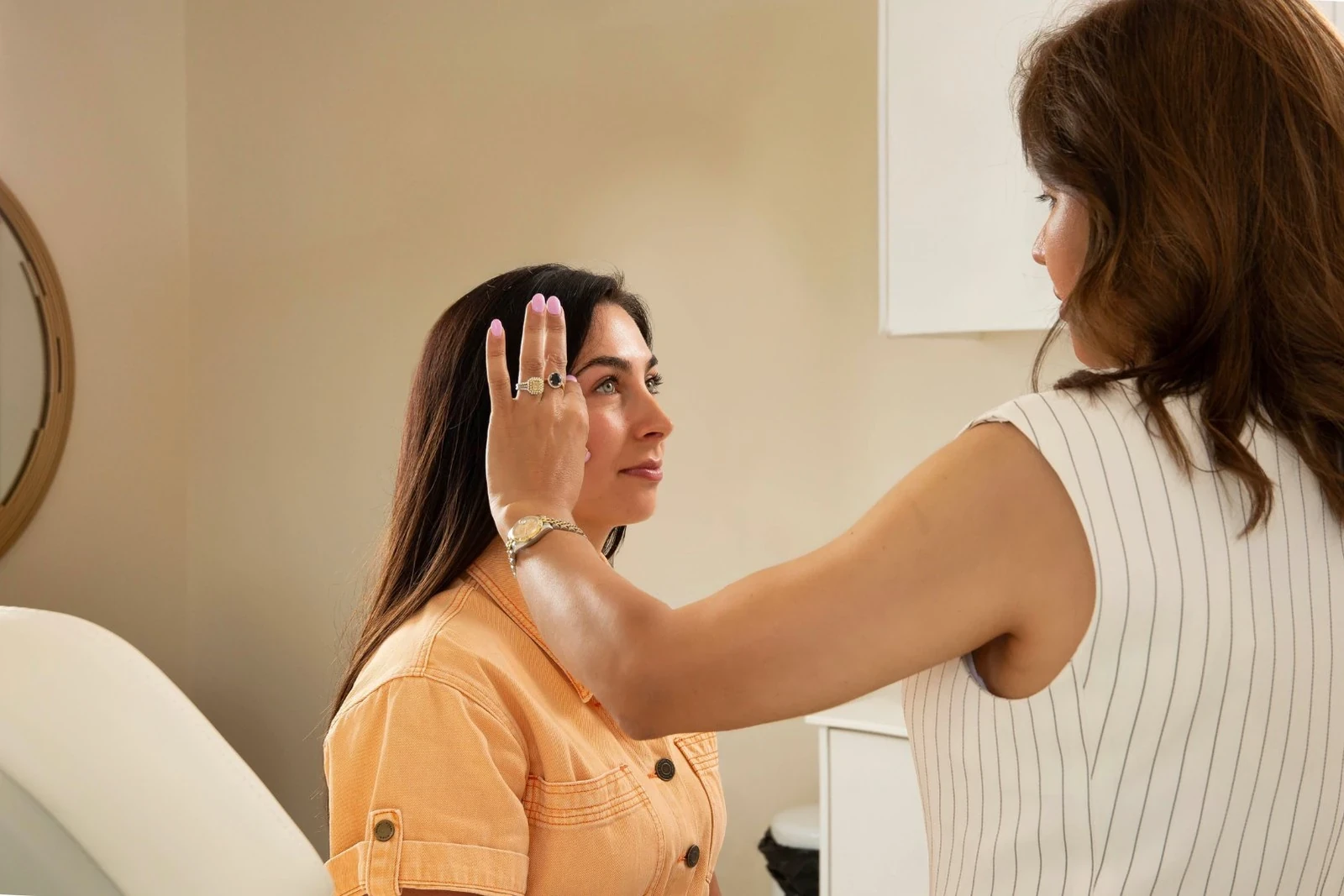
Your consultation at our Brisbane clinic starts with a conversation about your concerns and what you would like to achieve. We review your medical history, carefully assess the stretch marks and the surrounding skin, and use skin analysis and baseline photography where appropriate to gain a better understanding of your skin's condition. We then explain our findings, discuss the treatment options that may be suitable for you, and answer your questions so you have a clear understanding of the benefits, possible risks, and alternatives before deciding whether to proceed. Risks & Complications →
Listening
Mapping & Assessment
Plan & Options
Treatments We
May Discuss
The treatments listed here are examples of what may be considered. They are not a treatment plan and do not mean you will need all of them. Stretch mark treatment is a tailored combination, not a single procedure, matched to the stage of the marks (red or white), their depth, where they are, and your skin type, then layered across several sessions over six to twelve months. Some marks are better treated elsewhere: vascular laser for redness that will not settle, or fully ablative CO2 resurfacing for severely textured mature marks. In those cases we refer you to a specialist dermatologist. The exact combination, sequence and number of sessions is decided at your consultation after your skin has been properly assessed at our Brisbane clinic.
Combined Treatment Plan
No single device clears stretch marks on its own. The best plans combine a few approaches into one staged course, built around your marks. We first map the marks by stage (red striae rubrae or white striae albae), depth, location and skin type. From there we design a sequence that suits you. A typical plan pairs RF microneedling (Morpheus 8 or Vivace) for the deeper collagen work with skin needling and special serums for surface texture. We add Skin Booster or Rejuran where the marks are sunken (atrophic), and Healite II LED between sessions to support healing and calm any lingering redness. Topical treatments run at home across the course, and for early red marks a topical treatment is added where appropriate. Sometimes severely textured mature marks need a fully ablative laser, and we talk that through with you at your consultation. Most courses run over six to twelve months, with sessions four to eight weeks apart. The exact combination, sequence and number of sessions is decided at a full consultation. Individual results vary, and the goal is meaningful improvement, not erasure.
Skincare Plan & Home Care
Good home care is the foundation of any stretch mark plan. For early red marks (striae rubrae), a topical treatment may help, and we discuss whether one suits you at your consultation. Some treatments are not used during pregnancy or breastfeeding, so timing matters. Around this, we usually recommend a simple daily routine to keep the skin well hydrated and calm, along with good sun protection where the marks are exposed to the sun. We talk through the right home-care routine for you as part of your plan. No cream prevents stretch marks, and none has strong evidence for prevention. What good home care does is keep the skin comfortable, ease itching during the active phase, and support healing between in-clinic sessions.
Morpheus 8
This is the mainstay treatment for both red and white stretch marks. Morpheus 8 uses fine, gold-coated insulated pins to deliver controlled radiofrequency energy into the dermis, the deeper layer of skin, at depths adjustable up to four millimetres. The combination of needling and gentle heating prompts the skin's repair cells (fibroblasts) to make new collagen and elastin. This thickens the thinned skin under the marks and lifts their texture from inside. Because the energy is not absorbed by skin pigment, Morpheus 8 is safe across all skin tones. That matters for body work, where olive and darker skin can be more prone to pigment changes after light-based treatments. At our Brisbane clinic, a typical course is four to six sessions, four to eight weeks apart. Collagen keeps remodelling for six to twelve months after the final session.
Vivace RF Microneedling
A second RF microneedling platform, using 36 gold-plated pins with pulsed energy delivery designed to make treatment more comfortable. It works in the same way as Morpheus 8: fine needling channels plus controlled warming in the deeper skin to prompt new collagen. The pin and energy profile is a little different, which suits some skin types and body areas better. We choose between Morpheus 8 and Vivace based on the stage and depth of the marks, where they are, and our judgement after assessing you in person. Both can be used across a single course for different body areas.
Skin Peels
Medical-grade chemical peels for body skin, typically using glycolic acid (AHA) or lactic acid (AHA). Peels work primarily on surface texture, improving the smoothness and reflectivity of the skin around stretch marks rather than treating the dermal change directly. They are useful as a series for patients with mostly mild marks and good overall skin tone, and as an adjunct between RF microneedling sessions. Peel selection is conservative on body skin (which heals slower than facial skin) and especially conservative in olive and darker skin types to avoid post-inflammatory pigmentation.
Skin Needling with Premium Serum
Medical-grade microneedling combined with growth factor and hydrating serums applied during and immediately after treatment. The micro-channels carry the actives into the upper dermis. Useful for mild to moderate stretch marks, particularly in the early red stage, and as a maintenance treatment between RF microneedling sessions. Conservative depth settings are used on body skin to minimise post-procedure pigmentation risk, and the protocol is staged across several sessions, four to six weeks apart.
Clear & Brilliant
A gentle non-ablative fractional laser using two diode wavelengths (1440nm and 1927nm). Useful in stretch mark work for the texture component and for the partial repigmentation of mature white marks, particularly in lighter skin types where there is less risk of post-laser pigmentation flare. Often combined with RF microneedling across a single course, with Clear & Brilliant handling the surface and the RF handling the dermis. Conservative settings are essential on darker skin types.
Skin Booster
Skin Booster is an in-clinic treatment that may help where a mature stretch mark has left the skin thinned and slightly sunken. It is best suited to moderately sunken marks, where the dip comes from thinning rather than surface texture. At our Brisbane clinic, Skin Booster is often paired with RF microneedling within the same course, so the two work together. Whether it suits you, and how it would fit your plan, is decided at a one-on-one consultation.
Rejuran (Polynucleotide Skin Booster)
A bio-revitaliser based on polynucleotides, which are purified DNA fragments from salmon. Rather than adding volume, Rejuran works as a signal that tells the skin to repair itself. The skin's repair cells (fibroblasts) read it as a prompt to make new collagen and elastin. It is useful for sunken (atrophic) mature stretch marks and for the overall quality of the skin around them. We usually give it as a course of three to four sessions, two to four weeks apart. Results build gradually over the following months, and because the collagen you make is your own, the effect can last well.
PRX-Plus
A next-generation topical bio-revitaliser from WiQo (Italy). PRX-Plus stimulates the deeper layers of the skin and supports collagen production without visible exfoliation or downtime. Useful as a maintenance treatment between RF microneedling sessions, and for patients with mild to moderate stretch marks who want progressive improvement without procedural recovery time.
Healite II LED
Low-level light therapy. The near-infrared wavelength reduces inflammation and accelerates healing after RF microneedling, peels and skin needling. The yellow light component supports vascular regeneration in healing skin and reduces persistent redness, which is particularly useful in the early red phase of striae rubrae. Healite II is non-thermal, which means it does not aggravate inflammation. At our Newstead clinic in Brisbane, Healite II is built into stretch mark treatment plans as a regular healing-support step between procedural sessions.
CO2 Laser Resurfacing
For mature stretch marks where textural change, collagen loss, and surface irregularity are the primary concern, CO2 Laser Resurfacing may be discussed during consultation, where clinically appropriate. Treatment suitability depends on skin type, stretch mark stage, downtime preference, and medical assessment.
CoolPeel CO2 Laser
CoolPeel CO2 Laser offers a superficial resurfacing option with lower social downtime, and may be suitable where skin quality improvement around stretch marks is the goal and recovery time is a consideration. Suitability is assessed during consultation.
All cosmetic procedures carry some risk and possible side effects. Whether a treatment suits you, what might rule it out, and the full range of possible complications are all discussed at your consultation. Individual results vary, and no outcome can be guaranteed. Read about Risks & Complications →
A few questions
before a consultation?
If you would rather talk to our team before booking, we are happy to take a thoughtful phone call. No pressure, no obligation. Just a conversation.
Frequently
Asked
Stretch marks (the medical name is striae distensae) form when the skin is stretched faster than the deeper layer, the dermis, can make new collagen and elastin. The support fibres tear, and the visible mark is what shows once the skin heals over those small tears. The four most common triggers are pregnancy (where up to 90 percent of women develop them), puberty growth spurts (40 to 70 percent of teenagers), fast weight change in either direction, and fast muscle gain in bodybuilders. Hormones matter as well. High cortisol weakens the dermis, which is why Cushing syndrome, long-term steroid use, and sometimes the steroid creams used for eczema or psoriasis make stretch marks more likely. Family history is a strong predictor.
No. Stretch marks are permanent structural changes in the dermis and cannot be erased completely. What treatment can do is make them significantly less visible, by stimulating new collagen, improving texture, fading the red or purple colour in early marks, and partially repigmenting white marks. A properly planned course can meaningfully reduce their appearance, with the largest gains in patients treated while their stretch marks are still in the early red phase. Mature white stretch marks improve too, just more slowly and less dramatically. Individual results vary.
They are the same condition at different stages. Red and purple stretch marks (striae rubrae) are early. The colour comes from inflammation and the small blood vessels that show through the thinned, recently torn dermis. They are flat or slightly raised and itch in some people. White or silver stretch marks (striae albae) are mature. Over months to years the inflammation settles, the vessels close down, the pigment-producing cells in that strip of skin become less active, and the mark goes pale and slightly depressed. The difference matters because early red marks respond much better to treatment than mature white ones.
As soon as you notice them. Early stretch marks (still red, purple or pink) respond far more easily than mature white ones. A topical treatment course has good evidence for the early red stage and almost none for the mature white stage. RF microneedling such as Morpheus 8 or Vivace works on both, but gives more noticeable improvement when started early. The exception is pregnancy itself: most procedures wait until after birth and the end of breastfeeding. During pregnancy the focus is on steady hydration, gentle pregnancy-safe creams (such as a hydrating serum and centella asiatica), and protecting the skin from rubbing. At our Brisbane clinic we discuss the right starting point for your situation. Individual results vary.
RF microneedling courses for stretch marks are typically four to six sessions, four to eight weeks apart. Most patients see steady improvement across the course, with continued collagen remodelling for six to twelve months after the last session. A combination approach (RF microneedling alongside skin needling with serums, Skin Booster or Rejuran for atrophic marks, and topicals at home) generally outperforms a single technique. Treatment plans and likely session counts are estimated at your Brisbane consultation after the marks have been assessed in person. Individual results vary.
Partially, yes. The red or purple of striae gravidarum (pregnancy stretch marks) fades naturally over six to twelve months postpartum as the inflammation settles and the vessels close down. The texture, the indentation and the silvery final colour are what remain. That residual appearance can be improved with active treatment, but it does not resolve on its own. Treatment usually starts three to six months postpartum, or once breastfeeding has ended, depending on the procedure. Individual results vary.
All cosmetic procedures carry risks, including bruising, swelling, asymmetry, infection, vascular events, and unsatisfactory cosmetic outcome. Specific risks depend on the treatment and are explained in full at consultation and again on the day of treatment. Full information is available on our Risks & Complications page.

Dr Fatemeh Asadi MD, FRACGP
GP & Cosmetic Physician · Founder, Body Dezign House
Ready for a
Consultation or Treatment?
Book a time with Dr Asadi or her team at our Newstead clinic in Brisbane. New here? Begin with a consultation. Already consulted, or following a treatment plan you've discussed? Book your next session, or reach out with any other enquiry.